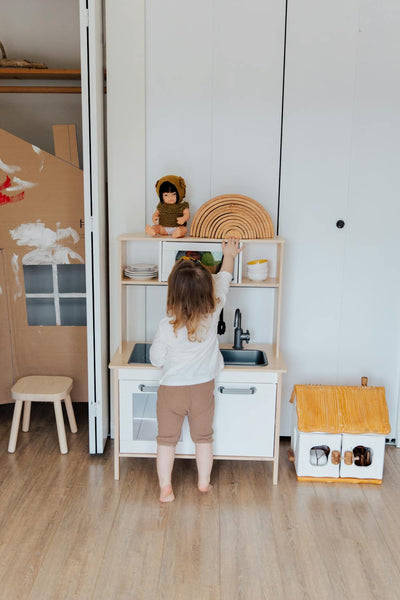
"I do it MYSELF." If you are the parent of a 3, 4, or 5-year-old, you have heard this sentence — delivered with fierce determination, possibly while your child is trying to put both legs through one trouser hole. The urge to dress independently is one of the most important developmental milestones of the preschool years, and how you respond to it shapes not just her mornings, but her confidence, motor skills, and sense of self.
Here is why it happens, how to support it, and how to survive the morning routine while you are at it.
The Developmental Psychology Behind "I Do It Myself"
When your preschooler insists on dressing herself, she is not being difficult. She is doing exactly what her brain is designed to do at this age:
Autonomy development. Between ages 2 and 5, children are in what developmental psychologists call the "autonomy vs shame" stage (Erikson's framework). Successfully doing things by themselves — including dressing — builds a fundamental sense of "I am capable." Being repeatedly prevented or corrected builds the opposite feeling.
Motor skill practice. Dressing involves a remarkable number of motor skills — fine motor (buttons, zips), gross motor (balancing on one foot to pull on pants), bilateral coordination (using both hands for different tasks), spatial awareness (figuring out which hole is for which arm). Every time she practices, these neural pathways strengthen.
Cognitive development. Getting dressed requires sequencing (underwear before pants, socks before shoes), categorisation (this is a top, this is a bottom), and problem-solving (the shirt is inside-out — how do I fix it?). It is a daily cognitive workout disguised as a mundane task.
When you understand that self-dressing is developmental necessity, not willfulness, your patience for the process expands considerably.
Setting Up a Self-Dressing-Friendly Wardrobe
The biggest thing you can do to support independent dressing is to make it physically possible. If her clothes are stored in a high cupboard she cannot reach, or if every outfit requires adult help with closures, you are setting her up for frustration.
Accessibility
- Store daily-wear clothes at her height — in low drawers, on accessible shelves, or on a low hanging rod
- Keep the most-worn items at the front or on top
- Use open bins or cubbies rather than closed drawers for younger preschoolers — seeing the options is half the battle
Simplicity
- Reduce the number of visible options. Three to four outfits to choose from is empowering; twenty is overwhelming
- Pre-pair outfits. Stack a top with its matching bottom so she can grab a complete outfit rather than making two separate decisions
- Eliminate the hard stuff from rotation. If a garment requires help to put on, it should not be in the self-serve section of the wardrobe
Organisation That a Child Can Maintain
Simple picture labels (a drawing of a shirt on the "tops" shelf, a drawing of pants on the "bottoms" drawer) help even pre-reading children maintain the system. For a full approach to kid-friendly wardrobe organisation, our wardrobe organisation guide has practical tips that work in Indian homes.
Clothing Items Ranked: Easiest to Hardest
Not all garments are equally self-dressing-friendly. Here is a realistic ranking:
Easiest (Start Here)
- Elastic-waist pants and shorts: Pull up, done. The gateway garment for self-dressing.
- Pull-on dresses: Over the head and finished. A-line styles are easier than fitted ones.
- Loose t-shirts: Wide necklines make these manageable from about age 2.5.
- Slip-on shoes: No fastening required.
Moderate (Ages 3-4 Can Learn)
- Tops with large snap buttons: One snap at the neck or shoulder.
- Front-zip jackets: Starting the zip is the hard part. Pulling it up is manageable. Teach the "pinch and pull" method.
- Velcro shoes: Easy to fasten, slightly harder to position correctly.
- Skirts with elastic waist: Similar to pants, but the concept of front-and-back can be confusing initially.
Harder (Ages 4-5 With Practice)
- Button-front shirts: Fine motor challenge. Most children manage large buttons by 4-4.5 and smaller buttons by 5.
- Fitted tops: Tight necklines require a specific over-the-head technique.
- Jeans with button and zip: The combination of unzip, unbutton, pull down requires sequencing.
Hardest (Ages 5-6+)
- Back closures of any kind: Requires reaching behind — a difficult motor task.
- Tying (shoelaces, sashes, drawstrings): Most children cannot reliably tie until 6-7.
- Small buttons, hooks, and eye closures: Require precision fine motor skills that mature around 5-6.
For the 2-3 year old wardrobe, stick to items from the "Easiest" category. As she grows, gradually introduce items from the next tier.
The Morning Routine Battle (and How to Solve It)
The most common battleground for self-dressing is the morning routine. You are pressed for time, she is determined to do it herself, and the result is a daily standoff that leaves everyone frazzled.
Strategies that actually work:
Build in time. If getting dressed independently takes her 10 minutes, wake up 10 minutes earlier. This is not a concession — it is an investment in her development (and your collective sanity). The time you "lose" in the morning, you gain back in reduced battles and a more cooperative child.
Choose the night before. The outfit decision and the outfit execution are two separate tasks. Do the choosing together the evening before — she picks from two or three parent-approved options. In the morning, the only task is putting on what was already decided. This eliminates 80% of morning conflict.
Use a visual routine chart. A simple picture chart showing the morning sequence — wake up, use toilet, brush teeth, get dressed, eat breakfast — gives her the structure to move through the routine with less prompting from you.
Offer help strategically. Instead of "Let me do it," try "Would you like me to start the zip and you pull it up?" or "You do the arms, I will straighten the back." You are helping without taking over, which preserves her sense of accomplishment.
Giving Choices Within Boundaries
Unlimited choice is paralysing for a preschooler. Constrained choice is empowering. The magic number is two to three options:
- "Do you want the pink dress or the blue top with shorts?"
- "Which leggings — the striped or the plain?"
- "These two outfits are good for today. You choose."
Both options should be ones you are happy with. She feels she has made the decision (because she has). You have ensured the decision is weather-appropriate, occasion-appropriate, and practically sound. Everyone wins.
When to Let Her "Win" the Outfit Fight
Not every outfit battle is worth fighting. Some guidelines:
Let it go when: She wants to wear mismatched socks. She insists on the same yellow top for the third day running (wash it at night). She wants to wear her favourite dress to the park even though it is "nice" clothes. The outfit is unconventional but not harmful, uncomfortable, or weather-inappropriate.
Hold firm when: The outfit is genuinely unsafe (sandals in pouring rain, no warm layer in Delhi winter). The occasion requires specific attire (a wedding, a school event). The clothes are actually dirty or damaged.
The more you let go on the small things, the more cooperation you get on the big ones. This is not permissive parenting — it is strategic parenting.
Age Milestones for Dressing Skills
Every child is different, but here are general benchmarks:
- Age 2-2.5: Can pull off loose clothing (socks, hat, unzipped jacket). Attempts to put on shoes (often on wrong feet).
- Age 2.5-3: Can pull on elastic-waist pants. Can put arms through sleeves when the top is held open. Pulls t-shirts on with help getting it over the head.
- Age 3-3.5: Can dress in simple outfits with minimal help. Manages pull-on shoes. Knows front from back on most clothes (but not always).
- Age 3.5-4: Can dress independently in easy clothes. Manages large snaps. Attempts front zips.
- Age 4-4.5: Manages front zips reliably. Learning buttons. Can put on socks correctly.
- Age 4.5-5: Manages most buttons. Can identify inside-out clothes and fix them. Reliably knows front from back.
- Age 5-6: Fully independent in all but the most complex closures. Learning to tie.
- Age 6-7: Mastery of all closures including tying. Can choose weather-appropriate outfits with guidance.
If your child is not meeting these milestones, it is rarely cause for concern. Provide opportunities and practice, and the skills will develop.
The Bigger Lesson
Self-dressing is not really about clothes. It is about the message you send your child every morning: "I trust you. I believe you are capable. I will help when you need it, but I will not take over because you can do this."
That message, repeated daily through something as simple as letting her pull on her own pants, builds a foundation of confidence that extends far beyond the wardrobe. It is one of the earliest, most tangible ways she learns that she is competent in the world.
So tomorrow morning, when she insists on doing it herself and the clock is ticking — take a breath. She is not being difficult. She is growing up. And she is doing it beautifully, one inside-out t-shirt at a time.