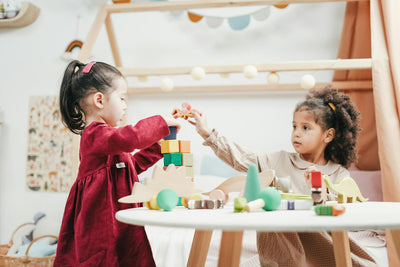
Six and seven is a turning point. Your daughter is firmly a "big kid" now, and she knows it. She notices what her classmates wear. She has a best friend whose outfit she admires. She might come home from school and announce that she needs "jeans like Ananya's" or ask why she cannot wear what she saw someone wearing on YouTube. Welcome to the age where peer influence meets personal style — and where your role shifts from choosing her clothes to guiding her choices.
The Shift Happening at This Age
Between 6 and 7, several things converge to change how your daughter relates to clothing:
Peer awareness becomes central. She is in Class 1 or 2 now, spending six to seven hours a day with the same group of children. She is observing, comparing, and wanting to belong. This is not vanity — it is a fundamental social development stage. Feeling that she looks "right" among her peers genuinely affects her confidence.
The concept of "cool" emerges. She may not use that word, but she understands the idea. Certain things are desirable, others are not. This awareness can be channelled positively — toward developing genuine personal style — or it can become a source of anxiety if mishandled.
Body awareness increases. She is more conscious of how clothes feel and look on her body. She may reject clothes that are too tight, too loose, too "baby-ish," or that make her look different from her friends. This awareness is healthy and normal.
Independence is expected. At this age, she is dressing completely independently. She should be able to manage all closures — buttons, zips, hooks, and even basic tying. If she cannot, her clothes might be too complex for her current skill level.
School Uniform vs Weekend Wardrobe
By Class 1, the school uniform dominates her week. Five out of seven days, her clothing is decided for her. This actually simplifies your wardrobe planning enormously — you only need to actively curate two days' worth of outfits (weekends), plus occasional non-uniform school days.
But those weekend outfits matter more than you might think. After five days in uniform, Saturday and Sunday are her chance to express herself. This is when her personal style gets exercised, and it is worth investing thought (and a reasonable portion of your clothing budget) into these pieces.
Uniform management tip: Four complete uniform sets is ideal. Two in rotation, one in the wash, one for emergencies. Iron on Sunday evening for the week. Replace any set that is getting visibly worn or tight — a shabby uniform affects confidence, even in young children.
Sports and Activity-Appropriate Clothing
At 6-7, many Indian children are in structured activities — swimming, skating, cricket, badminton, dance (Bharatanatyam, western, or both), martial arts, gymnastics. Each comes with its own clothing needs:
General sports: Comfortable stretch cotton or cotton-blend tracks, well-fitting t-shirts (not oversized — loose fabric can catch on equipment), good quality sports shoes. Avoid pure polyester if possible in Indian heat; cotton-poly blends breathe better.
Dance and gymnastics: Leotards or fitted tops with leggings. For classical dance, the teacher will specify requirements. For casual classes, keep it simple — nothing that restricts movement or that she constantly adjusts.
Swimming: A good swimsuit that fits properly. Replace annually — chlorine degrades swimsuit fabric, and a loose swimsuit creates drag and discomfort.
General tip: Keep activity clothes separate from everyday wear. Having a dedicated "dance class outfit" or "park clothes" reduces decision-making and keeps nicer clothes from getting grass-stained.
Developing Personal Style Without Growing Up Too Fast
This is the balance every Indian parent of a 6-7 year old grapples with. She wants to look "cool" and "grown up," but she is still a child. Here is how to navigate it:
Age-appropriate does not mean babyish. There is a wide range between "toddler prints" and "mini adult." A 6-year-old can wear a stylish striped dress, a denim jacket, a pretty floral top, or a smart co-ord set without looking too old or too young. The key is silhouette and fit, not necessarily pattern or colour.
Let her develop a signature. Maybe she always gravitates toward blue. Maybe she loves dungarees. Maybe she has a thing for hair accessories that coordinate with her outfit. Encourage these emerging preferences — they are the building blocks of personal style.
The comfort test still applies. No matter how much she likes something in the store, if it is uncomfortable during actual wear — itchy, restrictive, too warm, too tight — it will end up unworn at the back of the wardrobe. Every piece she owns should pass the "can she climb, run, sit cross-legged, and play in this?" test.
Talk about why you say no. If she wants something you think is inappropriate — too grown-up, impractical, or not aligned with your values — explain your reasoning in age-appropriate terms. "That top is designed for much older girls and would not be comfortable for your play" is better than just "No."
Wardrobe Essentials for a 6-7 Year Old
Weekend and Casual Wear
- Cotton tops in her preferred colours: 6-8 pieces — a mix of plain basics and a few printed or detailed ones
- Comfortable bottoms: 5-6 pieces — leggings, cotton pants, shorts, one or two denim or twill
- Casual dresses: 3-4 — these are her go-to for weekends and outings
- One versatile skirt: That can be dressed up or down
- Coordinated sets: 2-3 — still incredibly useful for no-thought outfit days
Party and Occasion Wear
- Birthday party dresses: 2-3 — comfortable, photogenic, and fun. At 6-7, she attends many parties, so these get good use
- Festive outfit: 1-2 — for Diwali, weddings, family celebrations. She may have input on the style now, which makes the shopping more enjoyable
- One "dressy casual" outfit: For restaurant dinners, family visits, or occasions that are not quite "party" but not quite "playground"
Layers and Outerwear
- Light jacket or denim jacket: 1 — this becomes a style piece as much as a functional one
- Cardigans: 2 — for AC and cool evenings
- Winter jacket: 1 — appropriate for your city's climate
Basics
- Innerwear: 7-8 pieces
- Sleepwear: 3-4 sets
- Activity-specific outfits: As needed
Birthday Party and Playdate Outfits
At this age, the social calendar picks up. A practical approach to party dressing:
The rotation system: Two to three party dresses that she rotates. Since she is attending parties with different friend groups, no one notices the repeat. This is far more practical than buying a new outfit for every party.
The quick-change outfit: Something she can change into quickly after school on a friend's birthday or a spontaneous playdate. A nice top and jeans or a simple printed dress works perfectly.
Let her own the choice. For a party she is excited about, let her choose her outfit from what is available. The sense of ownership boosts her confidence walking into a social situation.
Practical footwear matters. The prettiest dress is undermined by uncomfortable shoes. At 6-7, she needs shoes she can run in at a party. Flexible-sole sandals or smart sneakers beat stiff formal shoes every time.
The Influence of School Friends
Let us address this directly because it catches many parents off guard. Your daughter will come home saying things like:
- "Prisha has a dress with sequins. I want one too."
- "Everyone wears jeans on Saturdays. I need jeans."
- "Meera said my top is for babies."
These moments feel loaded, but they are normal. Here is how to handle them:
Take the request seriously, not literally. "I need jeans" might really mean "I want to feel like I fit in." You can address the underlying need without necessarily buying jeans — or you can buy the jeans if they are a reasonable addition to her wardrobe. The point is to listen to what she is actually asking for.
Use it as a teaching moment (gently). "It is nice that Prisha has a pretty dress. You have some lovely dresses too. Everyone's clothes are different, and that is what makes us interesting." This normalises difference without dismissing her feelings.
Watch for persistent distress. An occasional "I want what she has" is normal. A child who is consistently unhappy about her clothes, avoids getting dressed, or seems anxious about her appearance at school may need a closer look — at her wardrobe, her social situation, or both.
Growth and Sizing at 6-7
Growth continues to decelerate. Most children grow 5-6 cm per year at this age, and weight gain is steady but gradual. Clothes bought at the start of age 6 will often last comfortably through age 7, especially if you buy with a small margin.
Key sizing notes for Indian children at this age:
- Average height range: 108-125 cm
- Average weight range: 16-24 kg
- Chest: 54-60 cm
- Many children fall between standard sizes — when in doubt, size up rather than down
For a detailed comparison of how Indian kids' sizing works compared to international brands, the age guide from the previous stage is worth revisiting.
Looking Ahead
As she approaches 8, the tween transition begins to appear on the horizon. Peer influence intensifies, social media may start to enter her awareness, and the gap between "kid" clothes and "teen" clothes starts to feel relevant. The 8-10 year old guide will help you navigate that next stage when the time comes.
But right now, at 6-7, she is in a beautiful sweet spot — old enough to have genuine style preferences, young enough to still love play and comfort, and open enough to your guidance that you can shape her wardrobe together as a team.
The Essence of Dressing a 6-7 Year Old
Respect her opinions. Prioritise comfort. Let her experiment within boundaries. Keep the wardrobe lean and versatile. And remember that every time she gets dressed in something she genuinely likes and feels good in, you have given her a small but real confidence boost for the day ahead.
That is worth more than any amount of clothing.